
Why Do My Gums Bleed When I Brush?
What bleeding gums usually mean, how to stop them at home, and when it is time for a dentist to take a look.
Gums that bleed when you brush are most often a sign of gingivitis, an early form of gum disease caused by plaque building up at the gumline. Caught early, it is fully reversible with a professional cleaning and better daily care. If your gums still bleed after two weeks of gentle brushing and daily flossing, it is time for an exam.
Gums still bleeding after two weeks? Get a clear answer at a new patient exam.
3607 Oak Lawn Ave, Suite 250, Dallas · Mon & Wed 10–7 · Fri 3–7 · Sat 10 AM–8 PM · Todo nuestro equipo habla español.
Why do my gums bleed when I brush?
Plaque is a sticky film of bacteria that forms on teeth every day. When it sits along the gumline, the gums react by becoming red, puffy, and tender. Inflamed gum tissue has more blood flowing through it and a thinner surface, so the pressure of a toothbrush or floss makes it bleed. That is gingivitis, and it is by far the most common reason for bleeding gums.
Gingivitis usually does not hurt, which is why many people ignore it. The bleeding is often the only early warning you get.
Other causes include:
- Brushing too hard or using a hard-bristled brush. Scrubbing can irritate even healthy gums.
- Starting to floss again. Gums that have not been flossed in a while often bleed for the first week or two, then settle down.
- Tartar buildup. Once plaque hardens into tartar, a toothbrush cannot remove it. Only a professional cleaning can.
- Pregnancy and hormonal changes. Hormone shifts make gums more reactive to plaque, and pregnancy gingivitis is common.
- Medications. Blood thinners make any bleeding more noticeable, and some blood pressure and seizure medications can cause gum overgrowth.
- Smoking. Smoking can actually hide bleeding by reducing blood flow to the gums, so gum disease in smokers is often found later.
- Diabetes. Poorly controlled blood sugar makes gum infections more likely and harder to heal.
- Rarely, a medical problem. Bleeding gums together with easy bruising, frequent nosebleeds, or unusual tiredness can point to a vitamin deficiency or a blood disorder. Tell your physician as well as your dentist.
Is it gingivitis or periodontitis?
Gum disease has two broad stages, and the difference matters for treatment.
| Gingivitis | Periodontitis | |
|---|---|---|
| What is happening | Gums are inflamed from plaque at the gumline | Infection has moved below the gumline and is breaking down bone |
| Common signs | Bleeding when brushing or flossing, red or puffy gums | Bleeding plus receding gums, bad breath, loose or shifting teeth, pus |
| Pain | Usually none | Often none until it is advanced |
| Reversible? | Yes, fully | Bone loss does not grow back, but the disease can be controlled |
| Typical treatment | Professional cleaning and better home care | Deep cleaning below the gumline, more frequent maintenance visits, sometimes laser therapy |
Periodontitis is common. The CDC estimates that roughly four in ten American adults age 30 and older have some form of it, and many do not know. It is also the leading reason adults lose teeth. Research has linked gum disease with diabetes and heart disease, which is one more reason not to wait.
You cannot tell which stage you have by looking in the mirror. A dentist measures the small space between each tooth and the gum, called the pocket depth, and checks X-rays for bone loss. That takes a few minutes and gives a clear answer.
What can I do at home to stop bleeding gums?
If the bleeding is mild and recent, start here. These steps follow general ADA guidance:
- Brush twice a day for two minutes with a soft-bristled brush, angled toward the gumline, using small gentle circles instead of hard scrubbing.
- Floss once a day, curving the floss around each tooth and slipping it just under the gumline. Expect some bleeding at first. Keep going.
- Use a fluoride toothpaste and, if you like, an antiseptic mouth rinse approved by the ADA.
- Do not smoke or vape. Tobacco slows gum healing.
- Watch the timeline. With consistent care, gingivitis bleeding usually improves within one to two weeks.
What home care cannot do is remove tartar or treat infection below the gumline. If the bleeding has not improved after two weeks, or you notice any of the warning signs below, book an exam.
When should I see a dentist for bleeding gums?
Book a visit if you notice any of these:
- Bleeding that continues after two weeks of good brushing and flossing
- Gums that look red, swollen, or shiny, or feel tender
- Gums pulling back so teeth look longer
- Bad breath or a bad taste that does not go away
- Teeth that feel loose or a bite that feels different
- It has been more than a year since your last cleaning
Some gum problems should be seen the same day. A swollen bump on the gum, pus, or throbbing pain can mean an abscess, which is an infection that will not clear on its own. Our guide to dental abscess signs explains what to look for. Go to an emergency room for facial swelling with fever, swelling that makes it hard to breathe or swallow, or bleeding that does not slow after 15 minutes of firm pressure.
What happens at a gum checkup at Bleu Dentistry?
New patients can start with the $159 New Patient Special, which includes digital X-rays, a full exam, a cleaning, laser treatment, and fluoride. During the exam, your dentist checks your gum pocket depths, looks at bone levels on the X-rays, and tells you in plain language what is causing the bleeding.
- If it is gingivitis, a professional cleaning removes the plaque and tartar, and you get simple home-care steps. Most patients see the bleeding stop within a couple of weeks.
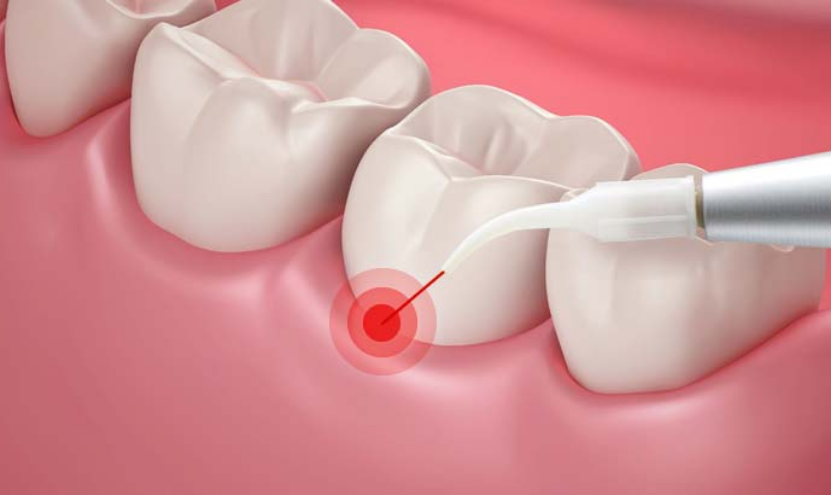
- If it is periodontitis, the usual next step is a deep cleaning, also called scaling and root planing, which cleans the root surfaces below the gumline so the gums can reattach. Bleu Dentistry also uses dental laser therapy to treat infected gum tissue with less bleeding and swelling. After treatment, more frequent cleanings help keep the disease from coming back.
Either way, you get a written treatment plan with prices before anything is done, so there are no surprises. Payment options are explained on our financing page, and nervous patients can ask about sedation options. Todo nuestro equipo habla español, so Spanish-speaking patients can ask every question in Spanish.
More on routine care is on our preventive care page and in our guide to how often you need a dental checkup.
When can I be seen?
Bleu Dentistry is at 3607 Oak Lawn Ave, Suite 250, near Uptown, Highland Park and Knox-Henderson. The office is open Monday and Wednesday 10 AM to 7 PM, Friday 3 PM to 7 PM, and Saturday 10 AM to 8 PM, so you can come in after work or on the weekend. Online booking is open at any hour.
| Day | Hours |
|---|---|
| Monday | 10 AM to 7 PM |
| Tuesday | Closed |
| Wednesday | 10 AM to 7 PM |
| Thursday | Closed |
| Friday | 3 PM to 7 PM |
| Saturday | 10 AM to 8 PM |
| Sunday | Closed (online booking open) |
Bottom line
Bleeding gums are usually gingivitis, and gingivitis is reversible. Brush gently, floss every day, and give it two weeks. If the bleeding has not stopped, or your gums are receding, swollen, or sore, have them checked before early gum disease turns into bone loss. New patients can start with the $159 New Patient Special at Bleu Dentistry in Oak Lawn and leave with a clear answer and a written plan. Meet our team or see what to expect as a new patient.
New patients: $159 for X-rays, exam, cleaning, laser treatment and fluoride.
3607 Oak Lawn Ave, Suite 250, Dallas · Mon & Wed 10–7 · Fri 3–7 · Sat 10 AM–8 PM · Todo nuestro equipo habla español.